Commercial property insurance is not a monolithic policy; it is a spectrum of specific protections, primarily defined by Basic, Broad, and Special Forms. Each form dictates which perils, such as fire or theft, are covered. For underwriters, brokers, and risk managers, mastering these distinctions is critical for structuring policies that accurately reflect a client's risk exposure and ensure operational continuity after a loss.
Navigating Commercial Property Insurance
In an environment of escalating climate volatility and complex supply chains, commercial property insurance has evolved from a simple expense to a core strategic asset. The focus is no longer on merely purchasing a policy but on deploying a critical defense mechanism that shields a business's physical assets from catastrophic financial losses. For insurance professionals, a functional, in-depth understanding of the different property insurance coverage types is foundational to protecting a client's enterprise value.
The financial stakes are significant and continue to climb. The global property and casualty insurance market was valued at USD 2.08 trillion in 2023 and is projected to reach USD 4.26 trillion by 2032. This growth is a direct reflection of the expanding value of commercial assets that demand precise, intelligent risk transfer solutions.
Establishing the Framework for Resilience
This guide provides a clear framework for building resilient insurance strategies, moving beyond standard definitions to deliver actionable insights. We will analyze the critical differences between coverage forms to enable more informed, strategic decisions for your clients.
Key takeaways include:
- Core Coverage Forms: A practical analysis of the foundational policies that underpin nearly every commercial property program.
- Strategic Endorsements: An examination of how to append custom protections to standard policies, thereby closing critical coverage gaps and addressing unique operational risks.
- The Evolving Risk Landscape: An assessment of modern threats, from cyber-induced property damage to catastrophic weather events, ensuring that client advisement is current and comprehensive.
A robust risk management plan is a prerequisite for effective insurance coverage. Preventative maintenance is a key component for mitigating common claims. For example, investing in proactive commercial plumbing maintenance is a practical measure that can prevent a catastrophic water damage claim.
For a review of fundamental concepts, our complete guide to commercial property insurance offers a comprehensive overview. The following sections provide the practical insights required to master this essential field.
Comparing Core Coverage Forms
Understanding the primary property insurance coverage forms—Basic, Broad, and Special—is analogous to understanding building construction. Each form builds upon the last, offering progressively comprehensive protection for commercial assets.
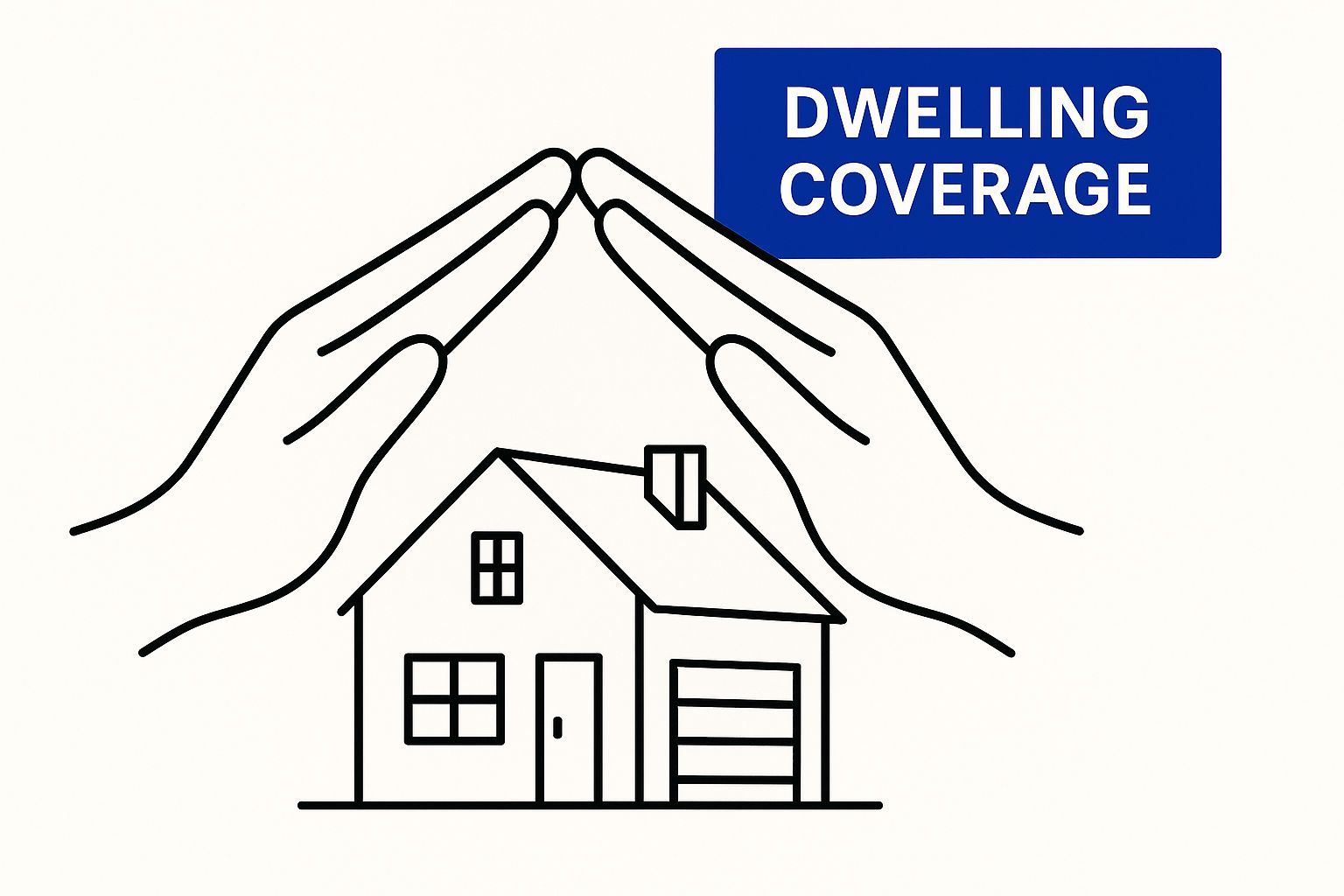
This visual provides a high-level overview of how these core coverages interrelate to form the foundation of a sound property insurance policy.
Image
As illustrated, dwelling coverage provides the essential structure upon which more specific, peril-based protections are layered.
The Basic Form: The Foundation
The Basic Form is the most fundamental type of property insurance available. It is a "named peril" policy, meaning that if a cause of loss is not explicitly listed, it is not covered. This provides a defined but limited scope of protection.
A Basic Form policy typically covers damage resulting from perils such as:
- Fire and lightning
- Windstorm and hail
- Explosion
- Smoke
- Vandalism
Practical application: A fire in a commercial warehouse causes significant smoke and structural damage. As both fire and smoke are named perils on a Basic Form policy, the insurer would cover the resulting losses. The coverage is straightforward but narrow.
The Broad Form: Expanding Protection
Building on the foundation of the Basic Form, the Broad Form incorporates all Basic Form perils and adds several others. This expansion provides a more complete layer of protection against a wider range of common loss events.
Additional covered perils often include falling objects, the weight of ice and snow, and specific types of water damage from plumbing or HVAC systems.
The primary advantage of the Broad Form is its coverage for more frequent, less catastrophic events that can still cause significant business disruption. This is critical for businesses exposed to a wider variety of operational risks.
For example, a commercial property owner using a landlord insurance comparison for California rentals will often find that a Broad Form policy provides a superior balance of cost and coverage for their portfolio compared to a Basic Form.
The Special Form: Comprehensive Coverage
The Special Form offers the most comprehensive protection available. It functions as an "all-risk" policy, which reverses the coverage structure. Instead of listing what *is* covered, it covers damage from any peril *except* for those specifically listed as exclusions.
This structure fundamentally shifts the burden of proof during a claim. With a Special Form, the insurer must prove an exclusion applies to deny a claim. Under Basic and Broad Forms, the policyholder must prove a covered peril caused the loss.
Common exclusions in a Special Form policy include:
- Flood and earthquake (requiring separate, dedicated policies)
- War and government actions
- General wear and tear or mechanical breakdown
- Ordinance or law (costs to upgrade a building to new codes post-loss)
This all-encompassing approach is the industry standard for most commercial properties, as it is essential for managing complex risks where a named-peril policy could leave significant and costly coverage gaps.
Direct property loss is only one facet of risk. To understand how these forms interact with other coverages during a crisis, review our detailed guide on business interruption insurance coverage.
This table provides a direct comparison of the perils covered under each form.
Comparison of Standard Coverage Forms
This reference table outlines the perils covered under the Basic, Broad, and Special property insurance forms.
| Peril | Basic Form | Broad Form | Special Form (All-Risk) |
|---|---|---|---|
| Fire or Lightning | ✓ | ✓ | ✓ |
| Windstorm or Hail | ✓ | ✓ | ✓ |
| Explosion | ✓ | ✓ | ✓ |
| Smoke | ✓ | ✓ | ✓ |
| Aircraft or Vehicles | ✓ | ✓ | ✓ |
| Riot or Civil Commotion | ✓ | ✓ | ✓ |
| Vandalism | ✓ | ✓ | ✓ |
| Sprinkler Leakage | ✓ | ✓ | ✓ |
| Sinkhole Collapse | ✓ | ✓ | ✓ |
| Volcanic Action | ✓ | ✓ | ✓ |
| Falling Objects | ✓ | ✓ | |
| Weight of Snow, Ice, Sleet | ✓ | ✓ | |
| Water Damage (Accidental) | ✓ | ✓ | |
| All Other Perils | ✓ (Unless Excluded) |
Each form builds upon the last, culminating in the comprehensive, exclusion-based coverage of the Special Form. Selecting the appropriate form requires a detailed assessment of the client's specific risks and risk tolerance.
Named Perils vs. All-Risk Policies
The strategic decision between a Named Perils policy (Basic and Broad Forms) and an All-Risk policy (Special Form) is fundamental. This choice dictates the burden of proof during a claim, which can significantly impact the outcome.

Image
For insurance professionals, understanding this distinction is paramount. The policy structure determines whether the client or the carrier is responsible for proving coverage applies after a loss, a factor that can determine the success or failure of a claim.
The Named Perils Approach
Under a named perils policy, if the cause of loss is explicitly listed, it is covered. If it is not on the list, it is not covered.
This structure places the burden of proof squarely on the policyholder. To receive payment, the business must demonstrate that the loss was a direct result of a specifically named peril. For underwriters, this offers predictability and contains the carrier's exposure to unforeseen events.
- Advantage for Insurers: Risk is clearly defined and bounded by the list of perils, simplifying pricing.
- Disadvantage for Policyholders: Any loss from an unlisted cause, regardless of severity, is the client's responsibility, potentially leaving significant coverage gaps.
Consider a business with a Broad Form policy. If a massive power surge destroys its servers, but a power surge is not a listed peril, the claim will be denied unless the surge can be proven to be the direct result of a covered event, such as a lightning strike.
The All-Risk Advantage
An all-risk policy, commonly known as a Special Form, operates on the opposite principle. It covers a loss from *any* cause unless it is specifically excluded. This reverses the claim dynamic.
With an all-risk policy, the burden of proof shifts to the insurer. The insurance company must prove the loss was caused by an excluded peril to deny the claim.
This offers a significantly broader scope of protection for the policyholder. For brokers, placing a client in an all-risk policy is typically the most effective strategy for shielding them from unexpected events that can threaten business viability.
When is an All-Risk Policy Essential?
While a named perils policy might suffice for a simple storage facility with predictable risks, it is inadequate for a complex manufacturing plant with specialized equipment and intricate processes. In such environments, an all-risk policy is not a luxury; it is a necessity. The potential for unusual, unlisted perils—such as chemical contamination from an adjacent facility or damage from a collapsed crane—is too high to be left uncovered. An all-risk policy provides a robust safety net, ensuring that coverage is in place unless the cause of loss is explicitly excluded.
Essential Policy Endorsements
A standard property insurance policy, even a comprehensive Special Form, often requires customization. Policy endorsements are the tools for this customization, allowing you to tailor a client’s protection to fit their specific, real-world operational risks.
These endorsements are strategic instruments for closing critical and potentially expensive coverage gaps. For brokers and underwriters, identifying the need for these endorsements elevates the relationship from a transactional policy sale to a strategic risk advisory partnership, focused on mitigating devastating uninsured losses.
Image
Business Interruption Coverage
Following a covered property loss that forces a shutdown, the subsequent financial impact often exceeds the physical damage. Business Interruption (BI) coverage, also known as Business Income coverage, is designed to replace the income a business loses during the period of restoration.
This coverage is vital for any business with significant ongoing expenses, such as payroll, rent, and loan payments. Without it, a temporary shutdown can lead to insolvency. BI ensures a covered property loss does not escalate into a complete financial failure by covering lost net income and continuing normal operating expenses.
Extra Expense Coverage
Working in tandem with Business Interruption is Extra Expense coverage. While BI replaces lost income, Extra Expense covers the *additional* costs incurred to minimize the shutdown period and maintain operations after a disaster—costs that would not normally be incurred.
Common applications include:
- Renting a Temporary Location: A manufacturing facility damaged by fire might rent a similar facility to maintain production and fulfill client orders.
- Leasing Equipment: A business can lease replacement equipment while waiting for a destroyed critical asset to be repaired or replaced.
- Overtime Pay: Paying employees overtime to accelerate repairs and recovery is a typical extra expense.
Ordinance or Law Coverage
This is one of the most frequently overlooked yet critical property insurance coverage types, particularly for older buildings. A standard policy typically pays only to repair a building to its *pre-loss condition*. However, if local building codes have been updated since the property was constructed, a simple repair may no longer be legally compliant.
Ordinance or Law coverage addresses the increased costs of rebuilding a damaged property to meet current building codes and regulations. Without it, the property owner is responsible for these often substantial mandatory upgrade costs.
For example, an older commercial building sustains significant fire damage. During reconstruction, the city requires the installation of a modern fire sprinkler system to comply with current code. The cost of this system would be excluded from a standard policy but covered under an Ordinance or Law endorsement.
Equipment Breakdown Coverage
Equipment Breakdown coverage, formerly known as "boiler and machinery" insurance, fills a significant gap left by standard property policies. Most forms specifically exclude damage from internal mechanical or electrical forces, such as a power surge destroying a server, a motor burnout, or a boiler explosion.
This endorsement covers the cost to repair or replace critical equipment following such an internal failure. For any business dependent on specialized machinery, HVAC systems, or complex electrical infrastructure, this coverage is non-negotiable. It protects the operational core of the business from failures that standard property policies are not designed to cover.
Coverage for Unique and Emerging Risks
Standard property policies are designed for traditional risks, yet modern threats are increasingly unconventional. For insurance advisors, understanding specialized property insurance coverage types for catastrophic and emerging perils is now a core competency for ensuring client survival.
Catastrophic events like floods and earthquakes are almost universally excluded from standard policies. Acknowledging and addressing these exclusions is the first step toward building a resilient insurance program. The financial impact of these gaps is significant. Between 2014 and 2023, natural catastrophes caused USD 2.35 trillion in global economic losses, yet only USD 944 billion was insured, revealing a 60% protection gap. You can learn more in this comprehensive global insurance outlook.
Addressing Catastrophic Exclusions
Standard policies exclude certain perils because their potential for widespread, catastrophic losses would destabilize a typical insurance pool. Risk managers and brokers must therefore be proactive in securing specific coverages to fill these gaps.
- Flood Insurance: A primary exclusion, flood damage requires dedicated coverage. This is available through the National Flood Insurance Program (NFIP), though a growing private market offers higher limits and more flexible terms.
- Earthquake Insurance: This covers damage from seismic activity, including shaking, cracking, and soil liquefaction. It is a critical consideration not only in traditional seismic zones but also in areas with induced seismicity from industrial operations.
- Cyber-Physical Coverage: Standard property policies are unlikely to respond if a cyberattack causes physical damage, such as hackers overloading industrial machinery to the point of failure. A specialized cyber policy or a specific property endorsement is required to bridge this gap.
Managing claims for these events requires specialized expertise. For a detailed analysis, review our guide on navigating natural disaster insurance claims.
The Rise of Parametric Insurance
As climate change increases the frequency and severity of weather events, the industry requires more responsive solutions. Parametric insurance offers an innovative approach that differs fundamentally from traditional indemnity-based policies.
Instead of paying for the actual loss incurred, a parametric policy pays a pre-agreed amount when a specific, measurable event trigger is met—for example, wind speeds exceeding 100 mph at a designated location or an earthquake reaching a certain magnitude.
The primary advantages are objectivity and speed. Payouts are rapid and bypass the often lengthy claims adjustment process. For a business impacted by a hurricane, this immediate capital injection provides critical liquidity for recovery efforts long before a traditional property claim is assessed. It is a powerful tool for managing risks where the speed of recovery is paramount.
Building a Resilient Insurance Strategy
The ultimate objective is to move beyond transactional policy sales and establish a strategic risk advisory relationship. For brokers and underwriters, this requires architecting a truly resilient insurance program based on a deep, operational understanding of a client's business—from supply chain vulnerabilities to specific geographical exposures. The goal is to build a program that anticipates threats rather than one that merely responds to losses.
This strategic approach is particularly relevant today. While most global property markets are expected to experience 'soft' pricing in 2025, some regions face challenging underwriting conditions that will impact limits and deductibles. This indicates that insurers are actively tailoring property insurance coverage types based on granular, localized risk assessments.
A Framework for Action
For brokers, the process begins with a thorough risk assessment to identify gaps in a client's existing coverage and determine the precise combination of forms and endorsements required. It also involves advising clients on loss prevention strategies.
A resilient strategy extends beyond the policy to encompass proactive property management. For instance, prioritizing routine HVAC maintenance is a practical measure for mitigating common and costly risks.
For underwriters, accurate pricing of layered risk is essential. A client with robust mitigation measures and a well-structured policy represents a fundamentally better risk than one with generic, off-the-shelf coverage.
Aligning policy structure with proactive risk management creates a foundation that can withstand significant business shocks. To further develop this approach, explore these effective business resilience strategies for building long-term stability.
Frequently Asked questions
When structuring property insurance coverage types, several critical questions consistently arise. Addressing these accurately is fundamental to building a policy that performs as intended during a claim.
Replacement Cost Versus Actual Cash Value
A crucial distinction is how a claim will be valued.
Replacement Cost Value (RCV) provides the funds to repair or replace damaged property with new materials of similar kind and quality, with no deduction for depreciation. This enables the client to be made whole without incurring out-of-pocket expenses.
Actual Cash Value (ACV) pays the replacement cost *minus* depreciation for age and wear. While premiums are lower, this method can create a substantial financial gap for the insured. For older properties or equipment, this gap can determine whether a business can afford to reopen.
The choice between RCV and ACV is a foundational risk management decision. For any business that must resume operations quickly with modern assets, an RCV policy is almost always the superior strategic choice, despite the higher premium.
The Impact of a Coinsurance Clause
The coinsurance clause is a provision that can create significant financial penalties if not managed correctly. It requires the insured to carry coverage up to a specified percentage of the property's total value, typically 80-90%.
If a property is underinsured at the time of loss, the insurer will only pay a fraction of the claim, calculated by the formula: (Amount of Insurance Carried / Amount of Insurance Required) x Loss Amount = Claim Payout. This makes accurate, current property valuations an absolute necessity.
Immediate Steps After a Property Loss
Following a property loss, and once safety is secured, the initial actions are critical for a successful claims process.
First, mitigate further damage. Advise clients to take reasonable steps to prevent the loss from worsening, such as boarding up windows or placing a tarp over a damaged roof.
Next, document everything. Comprehensive photo and video evidence from multiple angles is essential. Concurrently, the client should contact their broker or carrier to initiate the claims process. For major events, a pre-established disaster plan makes a significant difference. Knowing how to prepare for natural disasters can drastically improve both physical safety and financial recovery outcomes.
---
At Insurtech.bpcorp.eu, we provide real-time climate intelligence that transforms risk into opportunity. Our Sentinel Shield platform identifies businesses impacted by climate events, delivering actionable, high-intent leads to insurance providers, brokers, and recovery firms precisely when they are needed most. Discover validated opportunities and accelerate your growth with our pay-per-opportunity model.