
A robust commercial property insurance policy is the foundation for protecting a business’s physical assets—buildings, equipment, and inventory. For risk managers, brokers, and underwriters, mastering this coverage is non-negotiable for building resilient financial safeguards against catastrophic events like fire, theft, or natural disasters. This guide provides actionable insights for navigating the complexities of commercial property coverage in a volatile market.
What Is Commercial Property Insurance
Image
Commercial property insurance is a critical risk transfer mechanism designed to protect a company’s balance sheet from the financial impact of repairing or replacing physical assets following a covered loss. More than a policy, it is a strategic tool that provides the necessary capital to restore operations, preventing a single event from causing business failure.
This insurance provides the cash flow needed to resume operations, ensuring business continuity. For a complete perspective, it's essential to begin by understanding the role of insurance in financial planning. For industry professionals, a deep, practical grasp of how these policies are structured and applied is fundamental.
Key Assets Protected Under a Policy
A standard commercial property policy, often based on the CP 00 10 form, divides coverage into three primary categories. Accurate valuation within each category is critical to structuring a policy that performs as intended at the time of a claim.
- Building Coverage: This applies to the primary structure listed on the policy, including completed additions, outdoor fixtures such as signs or fences, and permanently installed machinery and equipment.
- Business Personal Property (BPP): This covers movable contents within the building. It includes furniture, computers, non-permanent machinery, and inventory or "stock." A practical test is to envision inverting the building—any item that would fall out is likely classified as BPP.
- Personal Property of Others: This coverage is essential for businesses that handle customer goods. It protects assets not owned by the insured but are under their "care, custody, or control," such as items in a repair shop or a third-party logistics warehouse.
>A critical detail for brokers and risk managers to address is the territorial limit on BPP and Personal Property of Others, which is often restricted to within 100 feet of the insured premises. This can create significant coverage gaps for businesses with large campuses or substantial outdoor storage.
The following table provides a concise breakdown of these core coverages.
Key Commercial Property Insurance Coverages at a Glance
The table below summarizes the essential policy components, clarifying the function of each coverage type in protecting a business's physical assets.
| Coverage Type | Assets Protected | Primary Purpose |
|---|---|---|
| Building Coverage | Physical structure, fixtures, permanent machinery | To fund the repair or rebuilding of the primary commercial structure. |
| Business Personal Property | Furniture, inventory, equipment, computers | To replace essential business contents needed for day-to-day operations. |
| Personal Property of Others | Customer goods, borrowed or leased equipment | To cover liability for third-party assets under the insured's control. |
Understanding these distinctions is the first step toward crafting a policy that provides comprehensive protection against property-related risks.
Breaking Down a Commercial Property Policy
A commercial property policy is the architectural blueprint for risk transfer. To structure effective coverage, it is crucial to understand how each component interacts to define the scope of protection a business receives.
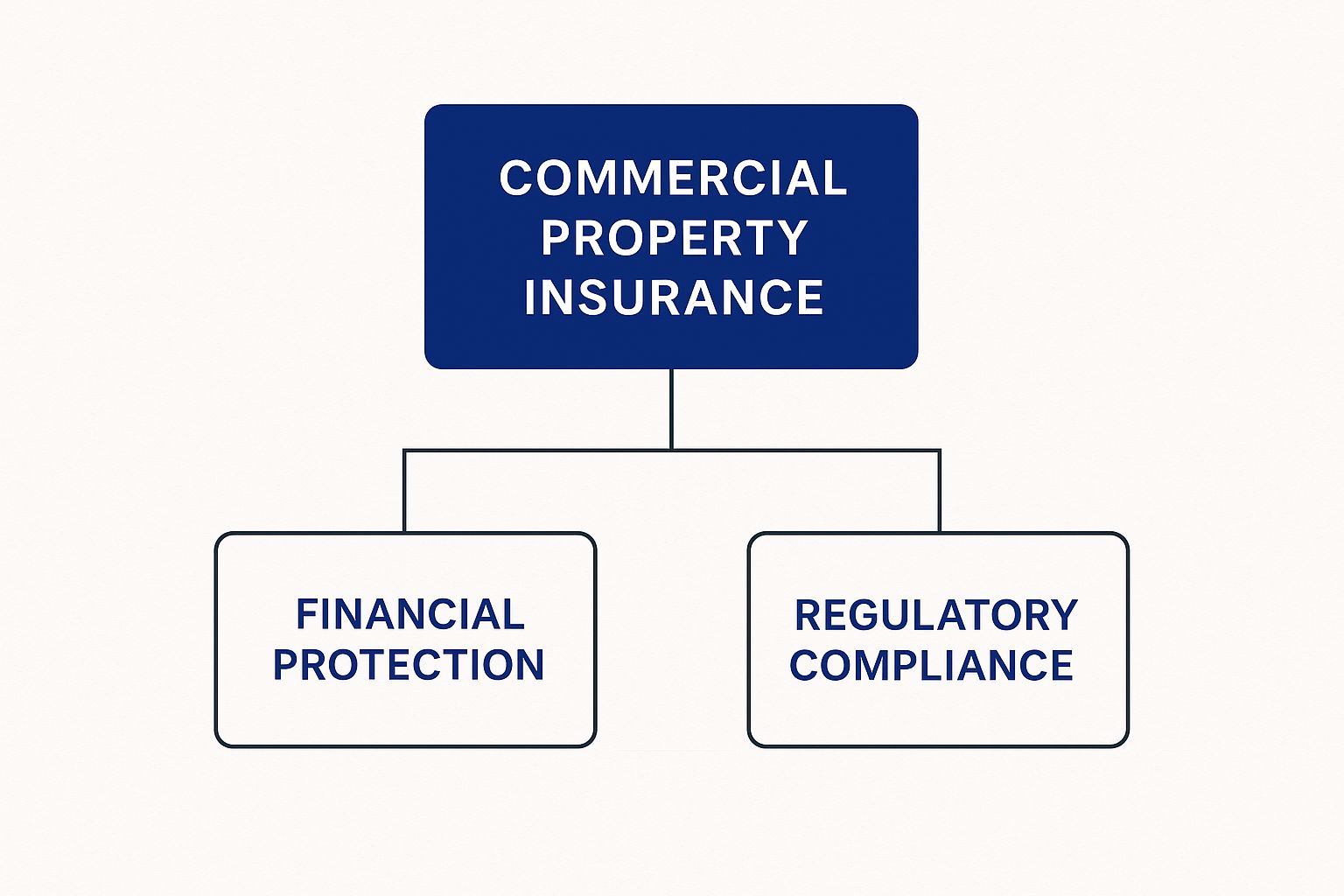
This diagram illustrates the dual function of a policy: providing a financial backstop after a loss while ensuring compliance with operational and legal obligations.
Image
The policy's core function is to restore a business's financial stability post-loss, which in turn enables the company to meet its other responsibilities.
The Declarations Page and Coverage Forms
Every policy begins with the declarations page, which summarizes the "who, what, where, and when" of the coverage. It identifies the insured, property locations, policy period, coverage limits, and premium. It serves as the executive summary of the insurance agreement.
Beyond the declarations are the coverage forms, which detail what is insured. While the CP 00 10 is the standard form, the most critical component is the "Causes of Loss" form, which specifies which perils are covered and which are not.
There are three primary Causes of Loss forms:
- Basic Form: A "named-peril" form that covers only perils explicitly listed, such as fire, lightning, windstorm, and vandalism. If a peril is not listed, it is not covered.
- Broad Form: This form expands on the Basic Form by adding a few more named perils, such as falling objects or the weight of snow and ice.
- Special Form: This "all-risk" form provides the most comprehensive protection. It covers all direct physical damage *unless* a peril is specifically excluded. This approach is superior as it shifts the burden of proof in a claim from the insured to the insurer.
>Actionable Insight: Brokers and risk managers should always advocate for the Special Form. Forcing the insurer to prove an exclusion applies, rather than requiring the insured to prove a named peril caused the loss, provides a significant strategic advantage in claims handling.
Understanding Exclusions and Endorsements
No policy covers every conceivable risk. Exclusions are specific events or conditions the policy explicitly will not pay for.
Standard exclusions in most property policies include:
- Flood
- Earthquake
- War and military action
- Intentional damage by the insured
- Wear and tear
Coverage gaps created by exclusions can be addressed with endorsements (or riders). These are modifications that add, remove, or alter the standard policy provisions. For instance, an ordinance and law endorsement can be added to cover the increased costs of rebuilding to current building codes.
Another crucial endorsement provides business income coverage. For many organizations, this is the most critical element for surviving a major disruption. Gain a deeper understanding by reviewing our analysis of how business interruption insurance coverage works.
The Role of Limits and Deductibles
The financial parameters of a policy are defined by its limits and deductibles.
The limit of insurance is the maximum amount the insurer will pay for a covered loss. Setting this limit based on the property's full replacement cost is essential to avoid underinsurance and a potential coinsurance penalty.
The deductible is the amount the insured must pay out-of-pocket before the policy responds. Whether a flat dollar amount or a percentage of the property's value, selecting the appropriate deductible is a strategic decision that balances premium costs against retained risk.
Understanding the Modern Risk and Rate Landscape

Image
Navigating the commercial property insurance market requires a clear understanding of the forces driving premium and capacity. The market is cyclical, alternating between hard markets characterized by high rates and restricted capacity, and soft markets where competition drives down pricing.
After several years of significant rate increases driven by catastrophic losses and economic factors, the market has entered a more complex phase. An influx of insurer capital has spurred competition, creating a nuanced environment for risk placement.
The Shift to a Mixed-Rate Environment
The current market is defined by its bifurcated nature. While new capital is exerting downward pressure on rates for many accounts, this relief is not universal. The market is experiencing a selective softening, not a widespread downturn.
This "mixed-rate" environment has made risk quality the primary determinant of pricing and terms. Underwriters are competing aggressively for well-managed, low-hazard properties while remaining highly cautious—or exiting completely—from accounts with challenging risk profiles.
>This market bifurcation is a critical point for brokers and risk managers to communicate to clients. A business with a modern, fully-sprinklered building in a low-risk zone will have a vastly different renewal experience than one with an older, frame-construction building in a wildfire-exposed area. Setting realistic expectations is paramount.
Unpacking the Rate Dynamics
The commercial property market reached a turning point in 2024. After years of steep increases, premiums for most accounts began to moderate, a trend expected to continue. Top-tier properties experienced renewal rate decreases of 10-20%, while average placements saw reductions of 5-15%. This is a classic indicator of a market with excess capital and renewed insurer appetite for market share. For a detailed analysis, see the 2025 P&C Market Outlook.
However, this softening did not extend to all segments.
High-risk categories—such as vacant properties, buildings in wildfire zones, and certain multi-family habitational risks—continued to face rate pressure and stringent underwriting. Premiums in the excess and surplus lines market for these challenging accounts increased by as much as 33%. This demonstrates insurers' continued aversion to assets with high loss potential.
Navigating High-Risk Categories
Even in a softening market, certain property characteristics will consistently attract greater underwriting scrutiny and higher premiums. Awareness of these factors enables brokers and risk managers to anticipate challenges and prepare a stronger submission.
Key high-risk factors include:
- Geographic Peril: Properties in areas exposed to hurricanes, floods, or wildfires face persistent rate challenges. The increasing frequency of severe weather events means a property's clean loss history is no longer a reliable predictor of future risk—a critical consideration for managing natural disaster insurance claims.
- Construction Type: Wood-frame construction is viewed unfavorably by underwriters, who prefer more resilient materials like steel or reinforced concrete, particularly for larger structures.
- Occupancy Risks: Certain occupancies, such as senior living or affordable housing, present unique liability and property risks that often result in higher insurance costs.
- Loss History: A history of prior claims is a significant red flag for underwriters, suggesting potential underlying issues with maintenance, management, or operational controls.
Placing coverage for properties with these characteristics requires a proactive and detailed approach. This includes meticulous documentation of risk mitigation measures, accurate valuations, and clear communication of the account's strengths. In this market, the quality of the submission distinguishes an acceptable risk from a declination.
The Double-Edged Sword: Climate Risk and Property Valuation
Two powerful forces are converging in commercial property insurance: the escalating frequency and severity of climate-driven catastrophes and the persistent issue of inaccurate property valuation. For underwriters, brokers, and risk managers, mastering both is now a core professional competency.
The correlation between climate events and insurer balance sheets is undeniable. As natural disasters intensify, they place extreme stress on reinsurance markets. Reinsurers price their capital to reflect this heightened risk, and these costs are passed down to primary insurers and, ultimately, to policyholders through higher premiums and reduced capacity.
Climate Perils and a Volatile Market
Weather is the primary driver of commercial property losses. In 2024 alone, insured losses from natural catastrophes in the U.S. reached an estimated $112.5 billion. This figure underscores the immense financial pressure on the insurance industry.
While the reinsurance market has recently stabilized, it remains highly sensitive to major loss events, keeping property premiums volatile. You can discover more insights about factors affecting insurance costs from Travelers to better understand these dynamics.
This high-risk environment compels underwriters to scrutinize geographic exposure with unprecedented detail. A property’s location is no longer just an address; it is a complex dataset indicating its vulnerability to specific perils. Acknowledging this reality is central to understanding how climate change impacts business operations.
>For brokers and risk managers, the strategic imperative is to shift the narrative from reactive recovery to proactive resilience. Presenting a clear, data-backed plan for mitigating climate threats can transform a property from a high-risk liability into a well-managed asset in the eyes of an underwriter.
The Underinsurance Trap and Soaring Replacement Costs
While climate change dominates headlines, an equally significant threat is underinsurance. When a property’s insured value fails to keep pace with its true replacement cost, the financial consequences of a loss can be devastating. This problem has been exacerbated by years of volatility in construction and materials costs.
Many policies are dangerously misaligned with current rebuilding expenses. This creates a significant coverage gap that often becomes apparent only after a claim is filed, leaving businesses with a substantial and unexpected financial shortfall.
Consider this scenario:
- A commercial building was valued at $5 million three years ago.
- Due to increased labor and material costs, its true replacement cost today is $6.5 million.
- If the policy limit remains at $5 million, the property is underinsured by $1.5 million.
This gap not only exposes the business in a total loss but can also trigger coinsurance penalties in a partial loss, further reducing the claim payment.
For insurance professionals, rectifying this discrepancy is a fiduciary responsibility. The most effective method is to advocate for regular, professional property appraisals. Using hard data to demonstrate the financial risk of underinsurance motivates clients to invest in accurate valuations, ensuring the policy can fund a full recovery.
Frame the Narrative with a Compelling Submission
Your renewal submission is the business case for your property. It is the opportunity to demonstrate why the account merits the most favorable terms.
An incomplete submission signals a reactive approach to risk management. In contrast, a detailed, data-rich presentation establishes your credibility as a proactive partner in loss prevention. Your objective is to anticipate an underwriter's questions and provide the answers upfront.
A winning submission must include:
- Detailed Statement of Values (SOV): Ensure property valuations are recent and reflect true replacement costs to avoid underinsurance penalties.
- Comprehensive Loss History: Provide five years of loss runs accompanied by a narrative that explains any significant claims and details the corrective actions taken to prevent recurrence.
- Documented Risk Improvements: Substantiate all capital improvements, such as a new fire suppression system or structural reinforcements, with invoices, photos, and inspection reports.
>An underwriter's primary objective is to write profitable business. A submission that clearly demonstrates a property's quality and the insured's commitment to risk mitigation makes their decision easier and positions the account as a desirable risk.
Translate Mitigation Efforts into Negotiation Power
A documented risk improvement plan is your most effective negotiation tool. Vague promises of future upgrades are insufficient. Underwriters require evidence of tangible, completed actions that have demonstrably reduced the property's loss exposure.
The commercial property market is currently defined by increased competition on price, driven by improved insurer profitability. However, the persistent threat of severe convective storms and an above-average hurricane forecast keeps risk management at the forefront of underwriting.
Early 2025 data confirms that insurers are laser-focused on risk quality. Documented improvements are the single most critical factor in securing favorable terms.
Prepare for a Successful Renewal Cycle
A successful renewal is a year-round process, not a last-minute task. This proactive approach ensures all necessary data is available when it is time to go to market. A well-defined business disaster recovery plan should be an integral part of this framework.
Follow this strategic timeline:
- Start Early: Initiate the renewal process 120 days prior to expiration. This provides ample time for data collection, underwriting inquiries, and market negotiation.
- Conduct Pre-Renewal Audits: Perform a physical inspection of the property to identify potential hazards. Review maintenance logs for fire protection systems and verify security protocols.
- Assemble Your Team: Convene key stakeholders from property management, finance, and operations. Their collective input provides a comprehensive view of the property's risk profile. Utilizing effective property management apps can streamline this data-gathering process.
By treating the renewal as a strategic opportunity rather than an administrative task, you position yourself to capitalize on market trends and secure optimal outcomes.
Using Climate Intelligence to Assess Risk
Relying on historical data to underwrite commercial property in the current environment is akin to driving while looking only in the rearview mirror. This backward-looking approach is inadequate for pricing risk and selecting profitable accounts in an era of unprecedented climate volatility.
The industry is undergoing a necessary evolution from an "art" based on experience to a science powered by data. This transformation is driven by advanced climate intelligence, which is reframing the core functions of underwriters, brokers, and risk managers.
From Macro Models to Micro Insights
Climate intelligence transcends broad, regional risk models by leveraging AI-powered tools to deliver granular, property-level data on specific perils like flood, wildfire, and severe convective storms. Instead of assessing risk at the county level, professionals can now analyze exposure down to the individual building footprint.
This precision enables underwriters to make more accurate and defensible pricing decisions. For brokers, it highlights unmitigated risks, providing a data-driven rationale for clients to invest in resilience measures.
>The primary value of climate intelligence lies in its forward-looking perspective. It uses predictive analytics to model *future* risk scenarios, allowing insurers to price for emerging threats rather than reacting to past losses. This proactive stance is essential for maintaining portfolio stability.
Actionable Data for a Strategic Advantage
The application of this technology creates a distinct competitive advantage across the insurance value chain. It is not merely about avoiding poor risks, but about identifying and correctly pricing desirable ones.
By integrating climate intelligence, insurance professionals can:
- Refine Risk Selection: Instantly flag properties with unacceptable exposure to perils that historical data may not reveal.
- Optimize Pricing: Justify premium adjustments with transparent, location-specific risk data, improving both accuracy and client trust.
- Enhance Lead Generation: Identify businesses impacted by recent weather events, creating targeted opportunities for brokers and recovery firms. Our guide on climate risk assessment tools explores these capabilities in detail.
As the industry adopts these systems, building confidence in the underlying AI is critical. For a deeper analysis of this subject, explore resources on AI Trust Through Understanding. Ultimately, climate intelligence provides the clarity needed to navigate the complexities of modern commercial property insurance.
Your Top Questions Answered
The following section addresses common, practical questions that arise for underwriters, brokers, and risk managers. Correctly understanding these concepts is critical for effective policy administration and claims outcomes.
What Is the Difference Between Replacement Cost Value and Actual Cash Value?
This is a fundamental policy choice with significant financial implications.
Replacement Cost Value (RCV) is designed to make the insured whole. It pays the cost to replace damaged property with new materials of like kind and quality, without a deduction for depreciation. The objective is to provide the capital necessary to fully rebuild and resume operations.
Actual Cash Value (ACV) pays the replacement cost *minus* depreciation. While ACV policies carry lower premiums, the claim payout may be insufficient to cover the full cost of rebuilding. This is a critical distinction to clarify with clients to ensure they are not underinsured at the time of a loss.
How Does a Coinsurance Clause Affect a Property Claim?
The coinsurance clause is a policy provision that encourages property owners to insure their assets to an adequate value, typically 80% to 100% of the replacement cost. If an insured fails to meet this requirement, a penalty is applied to partial loss payments.
For example: A building valued at $1 million has a policy with an 80% coinsurance clause. This requires the property to be insured for at least $800,000.
If the property is insured for only $600,000 (75% of the required amount) and sustains a $200,000 fire loss, the insurer will not pay the full loss. The payout will be reduced to 75% of the loss ($150,000), less the deductible.
>The clause effectively makes the policyholder a "co-insurer" for the percentage of underinsurance. This underscores why accurate property valuations are essential for avoiding a significant financial shortfall during a claim.
What Are the Most Effective Ways to Lower Insurance Premiums?
The most effective strategy for obtaining favorable terms is to demonstrate to underwriters that a property is a high-quality, well-managed risk. This requires a proactive, documented approach to loss control.
Actions that influence underwriting decisions include:
- A formal risk management plan: Written safety protocols and emergency procedures demonstrate a commitment to risk control.
- Physical risk mitigation: Capital investments such as modern fire suppression systems, upgraded security, or flood barriers provide tangible evidence of risk reduction.
- Clean, detailed submissions: A comprehensive and accurate submission package builds underwriter confidence and can lead to more competitive pricing.
A clear narrative of proactive risk management provides an underwriter with the justification needed to offer more favorable terms.
---
At Insurtech.bpcorp.eu, we turn climate risk into a competitive advantage. Our Sentinel Shield platform gives insurance pros the intelligence to find and connect with high-intent commercial leads right when they need coverage most. See how you can transform climate events into real business growth.